Business Tips
Barbara Sprenger
September 15, 2026
Written by Barbara Sprenger, Founder and CEO of Satellite Workplaces and Founder and CPO of Deskworks, with more than 15 years of experience opening and operating coworking spaces.
Opening a coworking space costs between $16 and $200 per square foot to build out, which puts a 10,000 square foot space somewhere between $160,000 for a budget do-it-yourself buildout and $2,000,000 for a luxury custom one. A standard buildout at that size lands around $400,000. Where you fall depends on the level of space you are creating, how much of the existing structure you can reuse, and how much of the buildout your landlord is willing to cover.
Running a coworking space is a great business. You're part of your community, you're helping people to start or grow their businesses, and if done right, you have a stable income.
And of course the standard economic answer applies. How much does it cost to open a coworking space? It depends.
Below is the actual breakdown, trade by trade, with the percentage of budget and the per square foot cost for each one.
There are two budgets you'll need to prepare: an operational budget and a capital budget. We'll primarily address the capital budget here, meaning what it will cost you to open your coworking space.
The capital budget is everything you spend once, before the doors open: walls, ceilings, HVAC, flooring, electrical, data, furniture, locks, and the systems that run the space. The operational budget is what you spend every month after that: rent, utilities, staff, cleaning, software, supplies and marketing.
The reason to separate them is that they get funded differently. Capital costs are usually financed, amortized over the life of the lease, or offset by a tenant improvement allowance from the landlord. Operating costs come out of membership revenue very soon after day one (hopefully!). Confusing the two is the fastest way to open a beautiful space that cannot make payroll or pay the rent in month four.
Let's take each capital component separately.
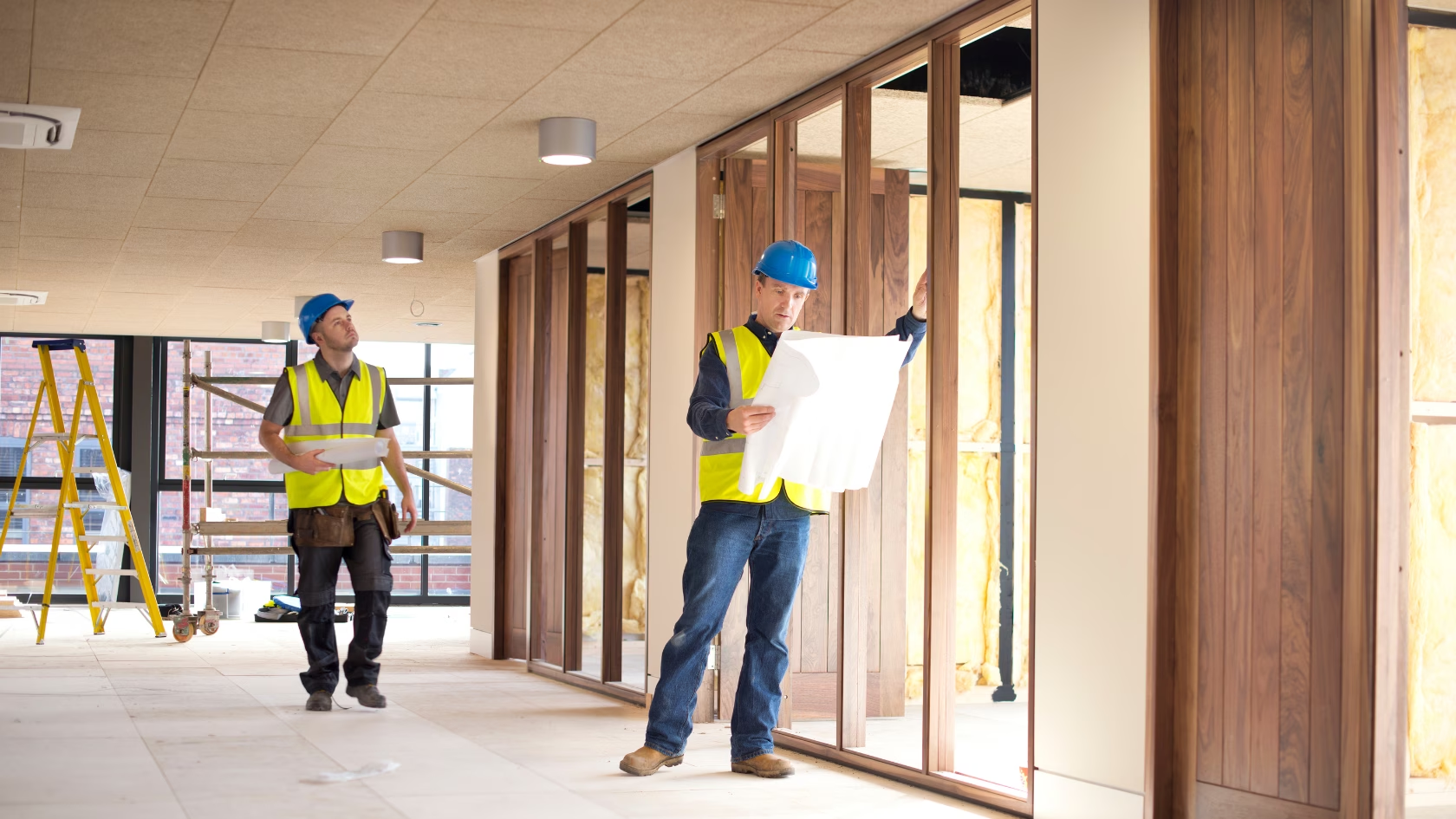
Buildout costs break into five trades, and each one has a predictable share of the total budget. The percentages below are what we use when we plan a new Satellite Workplaces location, and they hold up across a wide range of space sizes.
Your largest ongoing operational expense is almost always rent, so be sure you're thinking about this as you look at the capital outlay for the space. In many cases, your landlord will cover a significant portion of the space buildout or will give you free rent to cover a portion of the buildout.
First, decide what level of space you are providing. There are high-end coworking spaces that feel more like private clubs, and there are comfortable, neighborhood-feeling spaces. The amount you can charge for memberships will depend on where your center falls on this spectrum, assuming your market analysis is correct, and there is a market for the type of space you are creating. When the industry was starting, there was one chain of spaces that used ping pong tables for coworking desk space!
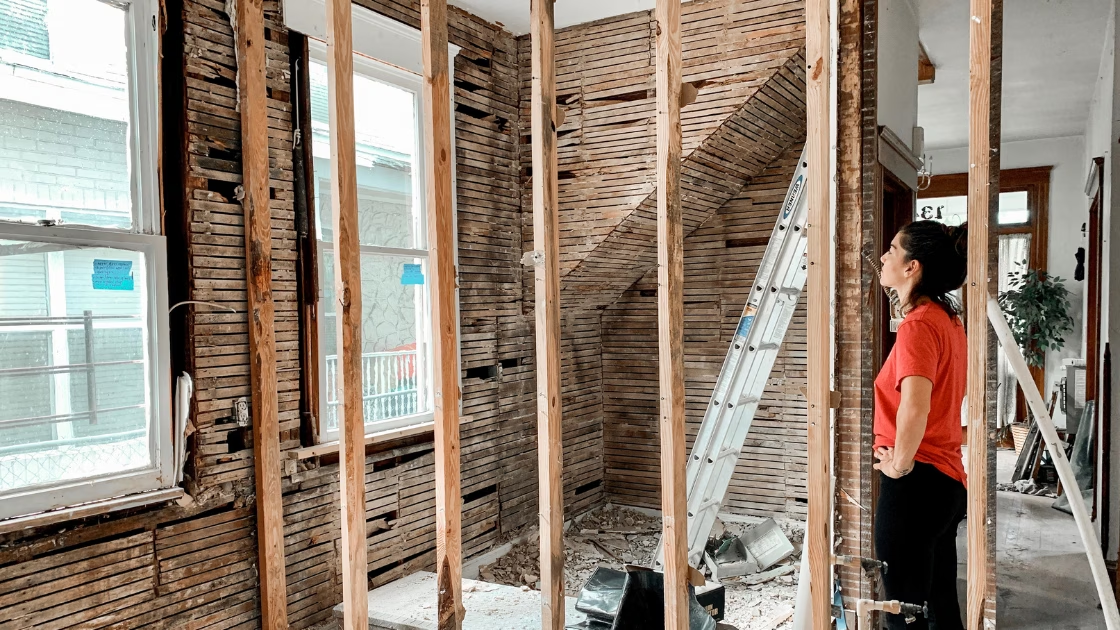
If you can, be opportunistic. If there are existing offices, do your best to use them in your design. However, if all of the existing offices are large, you will want to add walls to reduce the size of some of them to improve the revenue you can earn from the center. A one person office can be from 6'x10' to 8'x10', 2 person from 8'x10' to 10'x12', scaling from there. Whatever you do, though, be sure your walls are as sound resistant as you can get them (a subject for another post).
Plan the office mix before you plan the walls, because the mix is what sets your revenue ceiling. A floor with four large offices and no small ones caps how many members you can sell to, no matter how well it is finished. Mapping the layout against your membership plans first, and using interactive floor plans to model what you can actually sell, keeps you from framing walls twice.
It's also very important to have as much ceiling height as possible in shared areas. This can be more expensive than a drop ceiling, but the cost is well worth it. You will immediately reduce the value of your space if it feels like a shoebox, or a standard office. It's okay to have drop ceilings in private offices, but again, if you can get 10' ceiling height, do it.
Figure the basic buildout of walls and ceiling will range from about 20% to 32% of your buildout budget plus 20% to 30% for labor, or $5 to $25 per square foot.
Don't forget about the costs for your designer, architect, and permits. You will not have all of these costs in all cases, but they may be required in your area or by your landlord, or simply by the scope of your project.
A good designer or architect, one who really understands the trade-offs involved in coworking, can mean the difference between a business in which you are making the best use of your square footage and one that has a lot of waste or unproductive space.
Figure 3% to 5% of your budget for design and permits, or an average of $2.25 per square foot.
In many cases, the landlord will provide you with a working Heating, Ventilating and Air Conditioning (HVAC) system, but you may still have ducting that will need to be carried around to new offices or other spaces.
Be sure to write into your initial contract that you expect the HVAC system to be in good working order and that you expect the landlord to guarantee its functionality for at least the first year. This one clause has saved us more in unexpected expenses than almost anything else we negotiate.
Your HVAC costs can range from 10% to 15% of your budget, plus labor, or an average of nearly $7 per square foot plus labor.
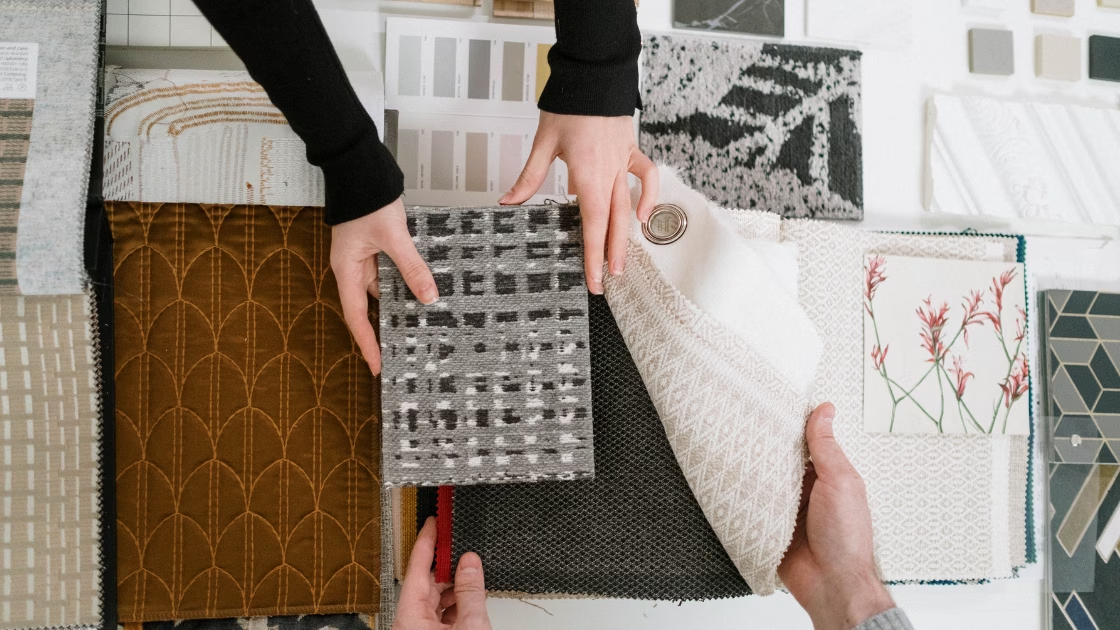
This is the fun part! Try to keep your color palette to three to four colors or less, so that your ongoing maintenance is easier. We've found that we can make beautiful accent walls from recycled rough-sawn lumber.
Carpet squares mean that you can replace a worn section without replacing the carpet in the entire space, although they are a bit more expensive. In a coworking space, you should always be thinking about sound transmission and noise levels, so carpet is a good, sound-absorbing material to use.
Paint, Finish and Flooring will be about 15% to 25% of your buildout budget, or an average of $11 to $12 per square foot plus labor.
If you don't have to build too many walls, you may be able to use a lot of the existing electrical system. In a coworking space, it's very important to have electrical outlets for every seat. If people can't charge their computer, the seat can be useless. You may want to consider charging stations with charged batteries available, in order to reduce the wiring needs in open space.
You will want wired data ports in offices. We have them as a feature in workstations as well. Most of your members will use wifi, so your data system will be built around a strong access point distribution. Getting the access point layout right at buildout is far cheaper than pulling cable through finished walls later, and the hardware choice matters more than most operators expect. Our guide to the best router for a coworking space covers what to specify before the electrician starts.
Lighting is one of the items that can set your space apart. This is where your design should shine! You don't have to spend an arm and a leg on light fixtures, however. There are great designs at very reasonable prices, but you want to be sure you have good quality fixtures. The ones you have to replace three months after opening work out to be very expensive.
Your electrical and data costs will range from 15% to 22% of your budget, with an average of $10 per square foot plus labor.
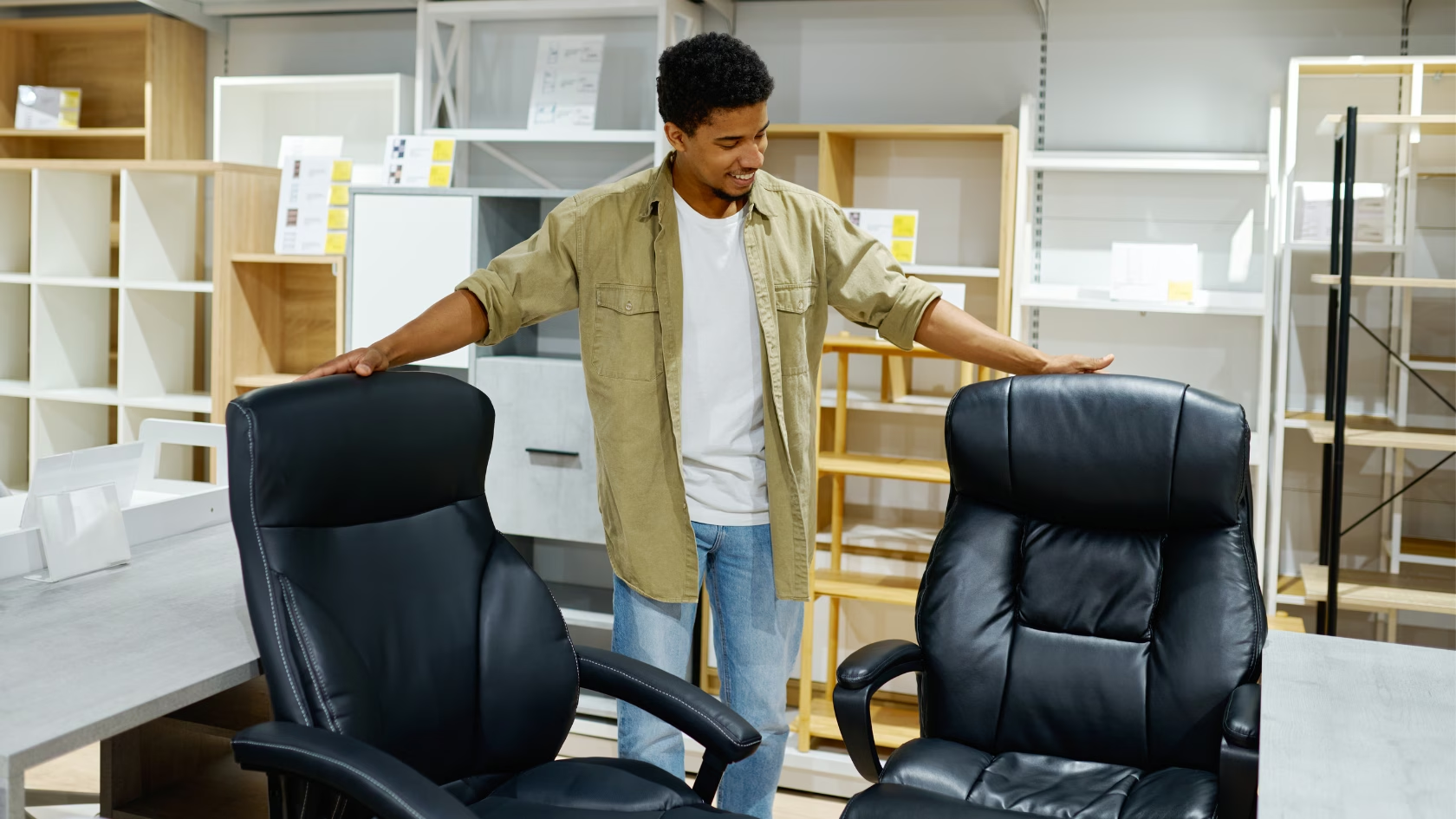
The five trades above cover the shell. Following are the items that get left out of first budgets and then show up as change orders.
The per square foot estimates roughly hold as you change the size of the space, so you can loosely budget any footprint from the same figures. Applying the $16 to $200 per square foot range gives you the following:
Smaller spaces tend to run higher per square foot than this table suggests, because certain components are needed at any size. A kitchen, a conference room, restrooms, an electrical panel and a data closet do not scale proportionately with size and are a bigger percentage of your budget at 3,000 square feet than at 10,000. Budget the low end of the range only if you are reusing significant existing structures.

The operating budget is a separate exercise, and it deserves its own post. In short, expect rent to be your largest monthly line item, followed by staff, then utilities, then software and marketing. Rent is the number to negotiate hardest, because it is the only monthly cost that is effectively fixed for the length of your lease.
The single biggest lever on the operating budget is how much of the daily work your systems handle instead of your staff. Member sign-up, payment collection, door access provisioning and Wi-Fi credentials can all run without a person touching them. That difference decides whether one Community Manager can cover a space or whether you need two. Our post on how to scale your coworking space goes deeper on which functions to automate first.
In the United States, according to Buildermuse, the average office space buildout ranges from $16 to $80 per square foot, with some custom buildouts costing up to $200 per square foot. For mid-range office spaces, tenant improvement costs are typically in the $50 to $75 per square foot range.
Cost for a 10,000 square foot coworking space:
The percentage of your budget to allocate for major components of a buildout are:
Coworking software is, in some ways, a capital decision that shows up on the operating budget, which is why it gets missed in first-time buildouts. The platform you choose determines how many of the systems above run themselves and how many need a person.
Deskworks is coworking management software built by operators, for operators. We built it running Satellite Workspaces, which is why it is priced and structured around the things that actually cost operators money.
Access control provisioning. The keyless locks in your buildout budget only save staff time if they are wired to your member system. Deskworks connects to the major access platforms through integrations with Kisi, Brivo, Salto, Avigilon Alta and Doorflow, so access is granted when a member signs up and revoked when they cancel, without anyone touching a fob.
Wi-Fi that uses your network as the check-in tool. The access point distribution you paid for in the Electrical and Data line can double as your occupancy tracking system. Intelligent Network Check-In recognizes members when they connect, so you get usage data without turnstiles or a front desk sign-in sheet.
Billing that runs without a bookkeeper. Billing and payment collection handles recurring memberships, prorated first charges, day passes and buckets of hours in one flow.
Reporting to justify the next buildout. Business analytics reports show occupancy and revenue per square foot, which is the number your lender or landlord will ask for when you open location two.
How much does it cost to open a coworking space?
A coworking space buildout costs $16 to $200 per square foot depending on the level of finish. For a 10,000 square foot space, that is roughly $160,000 for a budget do-it-yourself buildout, $400,000 for a standard one, $800,000 for premium, and $2,000,000 for luxury custom. Mid-range tenant improvement costs typically land in the $50 to $75 per square foot range.
How much does it cost to start a small coworking space?
A 3,000 square foot space at the budget end runs around $48,000 in buildout, and around $120,000 at a standard level of finish. Small spaces carry a higher effective cost per square foot than large ones, because a kitchen, conference room, restrooms and data closet do not scale proportionately with size and are a bigger percentage of your budget at 3,000 square feet than at 10,000. If you can reuse existing offices and an existing HVAC system, the low end is realistic.
What are the biggest startup costs for a coworking space?
Labor is the largest single line at 20% to 30% of the buildout budget. Walls and framing follow at 15% to 22%, electrical and data at 15% to 22%, flooring at 10% to 15%, and HVAC at 10% to 15%. Permits and design are the smallest line at 3% to 5%, and also the one most likely to pay for itself, because a designer who understands coworking recovers their fee in usable square footage.
How much does it cost to run a coworking space each month?
Rent is almost always the largest monthly expense, followed by staff, utilities, cleaning, software and marketing. The operating budget is a separate exercise from the capital budget and should be built before you sign a lease, not after. How much staff you need is largely a function of how much of sign-up, billing, access and Wi-Fi your software handles automatically.
Do you need coworking management software to open a space?
You can open without it, and plenty of operators start on spreadsheets, but it does not scale. Every manual sign-up, invoice, door code and Wi-Fi password is Community Manager time that could be spent on members, and none of it produces the occupancy data you need to price the next round of memberships. Coworking management software belongs in the initial budget, alongside the locks and the network.
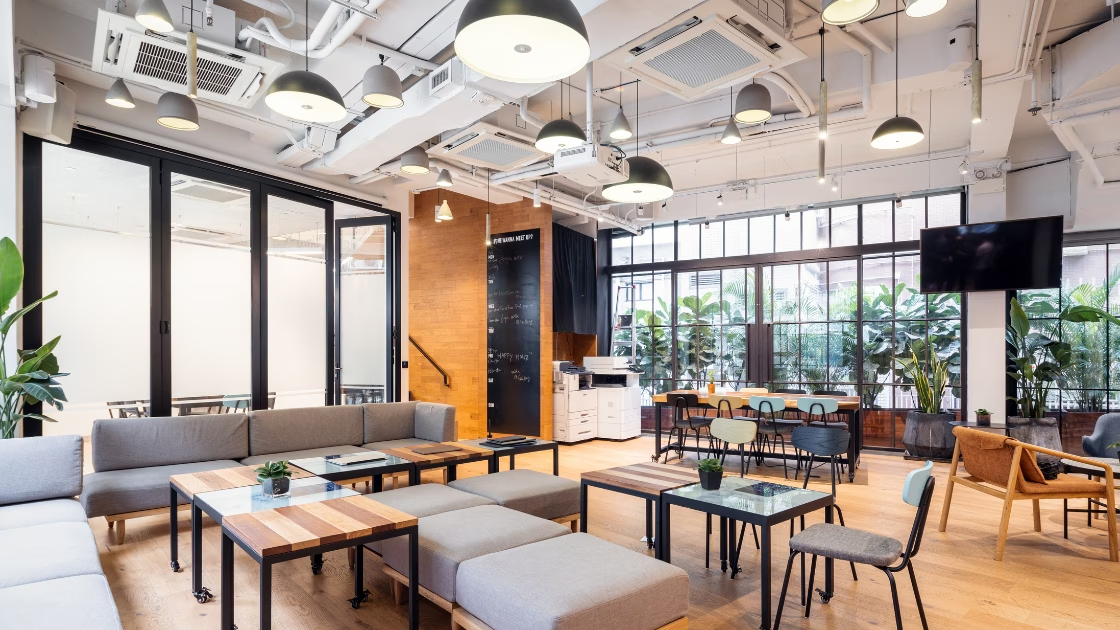
Every number above is a range, and where you land inside it comes down to how much of the existing structure you can reuse and how hard you negotiate the tenant improvement allowance. Get the capital budget on paper before you sign, and build the operating budget alongside it.
Business Tips
Barbara Sprenger
September 15, 2026
See how Deskworks helps coworking operators grow revenue while staying people-first.
Book a Demo

Deskworks is simple, powerful coworking management software built to automate your operations, capture every dollar of revenue, and give you more time to focus on your community.